
You Can Build Your Own AI Citation Monitor This Weekend (And That's Exactly Why You Shouldn't)
TL;DR
Generative AI makes building a first version cheaper than ever. But building is the cover charge — owning is the recurring subscription. The cheaper it is to start, the more likely you are to accidentally sign up for a problem portfolio you never intended to own.
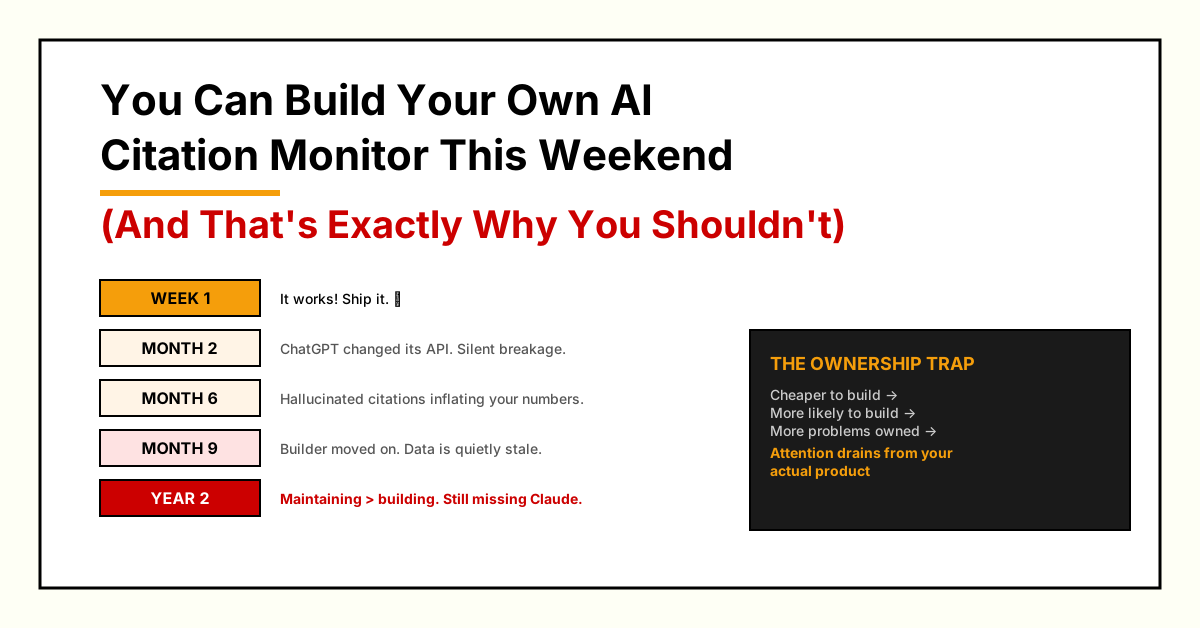
You built it in a weekend. Eighteen months later, you’re still maintaining it.
- Week 1 — You build a tool over the weekend. It works. You feel productive.
- Month 2 — An external dependency changes. The tool breaks silently. You spend a day debugging.
- Month 4 — A new feature or data source appears. The tool doesn’t cover it yet. You add it.
- Month 6 — Someone notices the output looks off. The tool has been faithfully processing garbage. You build a validation step.
- Month 9 — The person who built it is on a different project. Nobody has touched it in weeks. It’s quietly stale.
- Year 2 — You’re spending more time maintaining the tool than you ever spent building it. And it still has gaps.
Everyone knows this pattern. Nobody has a name for it — which means you can’t spot it until you’re already deep in it. Call it the ownership trap: when the cost of building is low, you build more things, and each thing you build becomes a problem you now own — until the total maintenance burden of what you’ve built exceeds the cost of what you could have bought.
Building is the cover charge. Owning is the recurring subscription — and it compounds.
If building still required a six-month engineering plan and a six-figure budget, most companies would just pay for the SaaS product. It’s precisely because building has become easy that companies are signing up for problem portfolios they never intended to own.
“Paying for software isn’t paying for a solution. It’s paying for someone else to own a problem — someone who has the taste and the context to think through the details, for the operations and structures necessary to scale it, maintain it, and solve even bigger things.”
— Quinn Keast, What, then, are we paying for?
You can build your own AI citation monitor this weekend
A competent engineer with access to ChatGPT can do it. Run queries against ChatGPT, Perplexity, and Claude, extract the citations, dump them in a database, show trends on a dashboard. Done.
But then OpenAI changes its web search output format. Perplexity launches a new feature. AI platforms hallucinate citations — URLs that don’t exist, quotes nobody said — and your monitor faithfully records all of them. The same query returns different results on different days. Claude adds web search and your competitors start showing up there but your monitor doesn’t cover it yet.
The script works today. Tomorrow it’s quietly stale.
This is the ownership trap in action. With generative AI, the answer to “can I build it?” is almost always yes. The real question is: do I want to own this problem?
The ownership trap is everywhere
This pattern isn’t unique to any one category. It plays out across every domain where generative AI has made building easy and owning hard.
Internal analytics dashboards
A growth team builds a custom analytics dashboard over a weekend using AI. It pulls data from three sources, renders the charts the VP wants, and replaces a $200/month tool. Six months later, one of the data sources changes its schema. The dashboard breaks. The growth team has moved on. The VP is making decisions on stale data. Nobody knows it’s broken because the charts still render — they’re just wrong. Total cost: three months of bad data plus the consultant fee to rebuild it, all to save $1,200. Classic ownership trap.
The feature that ate the roadmap
A product team builds an internal email delivery tool because the existing options don’t support one template format they need. It takes a week. Works great. Then someone asks for open tracking. Then bounce handling. Then they discover that deliverability across Outlook requires DKIM setup they didn’t anticipate. Each addition is small — a few days. But six months later, two engineers are spending a quarter of their time on an internal email tool instead of the feature the company actually sells. They missed a market window because their attention was on maintaining infrastructure, not shipping product. The 15% gap the custom tool solved cost them a year of roadmap momentum. Classic ownership trap — except the cost showed up as lost opportunity, not silent failure.
The pattern is always the same: cheap to start, expensive to keep, and the expense shows up as attention drain rather than line items on a budget.
The real objections (and why they’re half-right)
The build-it-yourself argument isn’t wrong. It’s incomplete. Here are the three strongest cases for building, and where they break down.
”I can iterate faster on my own tool”
True for the first version. You can ship a change in hours instead of filing a feature request. But iteration speed depends on having someone who understands the code, has time to work on it, and cares enough to keep going. After the first few months, your SaaS vendor — whose full-time job is iterating — will outpace your part-time attention. Your tool stops being a competitive advantage and becomes a maintenance obligation.
”What if the SaaS company goes under or raises prices?”
This is real, but it has a mirror image: what if the person who built your internal tool leaves? What if priorities shift and nobody picks up maintenance? SaaS companies have structured incentives to keep their product working — it’s how they make money. Internal tools survive on goodwill and momentum, both of which decay predictably.
The practical hedge: own your data, not your pipeline. Export regularly. Use standard formats. Choose tools with APIs over walled gardens.
The data you got from a SaaS product is yours. The institutional knowledge trapped in one person’s head — that’s the real lock-in.
”The existing solution doesn’t do exactly what I need”
It rarely does. But the question is whether the 20% gap between what a product offers and what you imagine is worth 100% of the ownership cost. Most gaps are narrower than they feel at first. If the gap is genuinely fatal — the existing solution cannot serve your use case at all — then building is right. But the threshold should be high. “Not perfect” is not the same as “not workable.”
The decision that matters: where your attention goes
Attention is the scarcest resource in any company. Not money. Not engineering talent. Attention. The question of where your team spends its mental energy is the most consequential strategic decision you make — and most companies make it by default rather than by design.
Every internal tool you build is an implicit commitment: some amount of engineering attention, every month, for as long as that tool needs to work. That attention comes from somewhere. It comes from the feature you didn’t ship. The customer problem you didn’t solve. The market opportunity you didn’t seize because your team was debugging an internal tool.
The decision framework isn’t complicated:
- Own problems that differentiate you — If the software is your product or your competitive advantage depends on it, own it
- Pay someone else for everything else — If a good-enough solution exists and the problem isn’t core to what you sell, the ownership cost of building will exceed the subscription cost of buying. Every time.
This is where AI citation monitoring lands for most companies. You need to know whether ChatGPT and Perplexity cite your brand. You need to know if your AEO efforts are working. But you don’t need to own the pipeline that collects that data — any more than you need to own the delivery infrastructure that sends your transactional email.
We built cite.me.in so you don’t have to own this problem. Start monitoring your AI citations and spend your attention where it multiplies.
Next time you’re tempted to build it yourself because it’s just a weekend project, ask: which problem am I choosing to own? And is it the one I actually sell?
FAQ
What does problem ownership mean in software?+
Why does generative AI make this worse?+
Can't AI also maintain the software it builds?+
When does it make sense to build in-house?+
How is problem ownership different from technical debt?+
Isn't this just an argument for not building anything?+
What about vendor lock-in?+
How do I evaluate whether to build or buy?+
Monitor your AI citation visibility

Co-Founder at cite.me.in
Co-Founder of cite.me.in and software engineer with deep expertise in AI, search, and open source. Previously defined industry standards in BPM and authored books on Ruby and Apache Buildr. He builds the product and leads the technical vision behind cite.me.in's AI citation monitoring platform.