
Why AI Traffic Converts 7x Better Than Search (And What That Means for Your Strategy)
TL;DR
HubSpot lost 140 million visits in a year to AI search. But AI visitors convert at dramatically higher rates — 7.3x higher in our own data. The traffic shift isn't a loss. It's a change in what traffic is worth.
HubSpot lost 140 million website visits in a single year because of AI search. The BBC reported on it this week, and the headline number is alarming. But the real story isn’t about losing traffic — it’s about what the remaining traffic is worth.
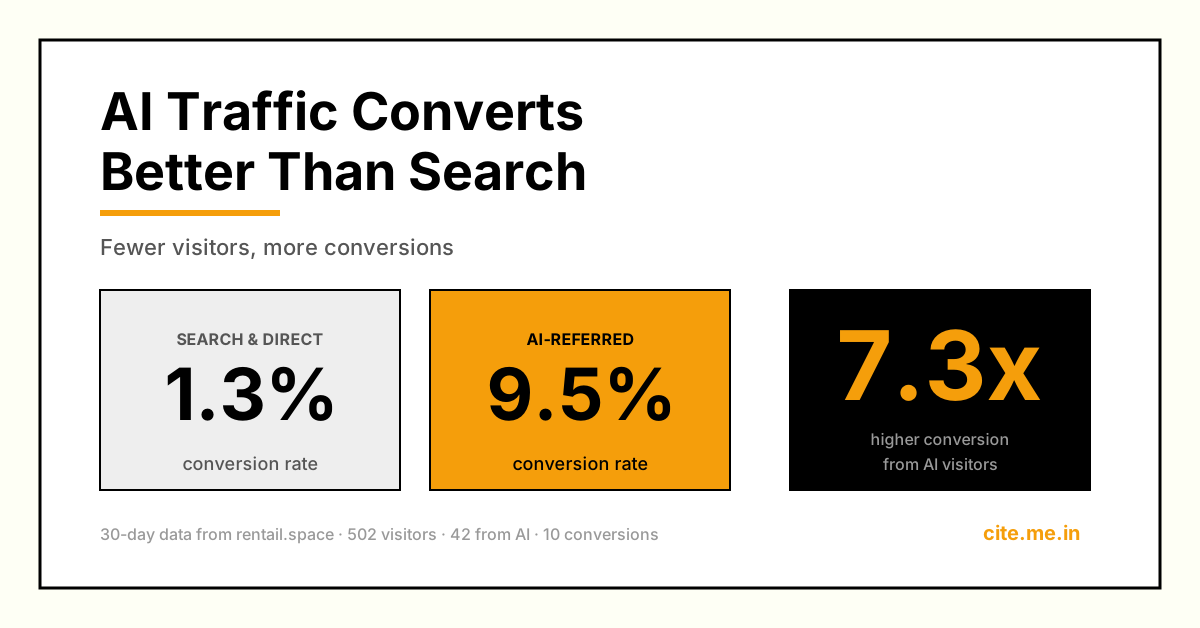
AI visitors convert at dramatically higher rates than search visitors. Multiple companies confirmed this in the BBC report. And we’re seeing it firsthand: one of the sites we monitor at cite.me.in — rentail.space — saw AI-referred visitors convert at 9.5%, compared to 1.3% for everyone else. That’s a 7.3x difference.
The traffic is shrinking. The value per visitor is going up. That changes everything about how you should think about your marketing.
The numbers tell a clear story
Google’s own AI overviews are eating the clicks that used to go to websites. When an AI summary appears at the top of search results, most users never scroll past it. They get their answer and move on.
The numbers from the BBC’s reporting:
- Click-through rates drop 60 to 70 percent on searches with AI overviews
- HubSpot lost 140 million visits in a year — driven by AI-generated summaries absorbing the traffic
- ChatGPT is now sending more visitors to websites than Google’s own built-in AI features
- MKM Building Supplies saw traditional site traffic declining as users got answers directly from AI
Users are making a conscious choice to go to ChatGPT instead of Google — even though Google has built-in AI. That’s a preference shift, not a glitch.
Andy Pickup, digital director at MKM Building Supplies, called it “a seismic shift in user preference.” Customers are making a conscious decision to skip Google entirely and go straight to ChatGPT.
Why AI visitors convert better
The difference comes down to where the visitor is in their research when they land on your site. A search visitor is still exploring. An AI visitor has already explored.
Here’s what we measured over the last 30 days on rentail.space, a commercial real estate marketplace we monitor at cite.me.in:
| Metric | Search & direct visitors | AI-referred visitors |
|---|---|---|
| Visitors | 460 | 42 |
| Conversions | 6 | 4 |
| Conversion rate | 1.3% | 9.5% |
| Relative performance | Baseline | 7.3x higher |
The sample is small, but the pattern matches what every company in the BBC report described independently. Andy Pickup at MKM Building Supplies said it directly: AI visitors are much more likely to buy than search engine visitors.
“On rentail.space, AI-referred visitors converted at 9.5% versus 1.3% for everyone else — a 7.3x difference. The visitors who come through AI recommendations arrive ready to act.”
— Assaf Arkin, Co-Founder at cite.me.in
The reason is the AI conversation itself. By the time someone clicks through from ChatGPT or Perplexity, they’ve already:
- Described their problem in detail — AI queries average 40–60 words, not the 4–6 keywords of a Google search
- Received a synthesized recommendation — The AI has already compared options and suggested your brand
- Built confidence in the choice — They’re not browsing 10 blue links; they’re following a recommendation
The research is done before the click. The visitor arrives informed, qualified, and ready to act. That compressed research cycle is the conversion lift.
The search query has fundamentally changed
AI search queries are an order of magnitude more specific than traditional search. This changes what kind of content gets cited — and who benefits.
Kipp Bodnar, CMO at HubSpot, described the difference: a traditional Google search is 4 to 6 words. An AI search query averages 40 to 60 words. That’s not a small shift — it’s a fundamentally different kind of question.
His example: instead of searching “motorhome rental New Zealand,” someone asks an AI to plan a complete family holiday for five people, including an opportunity to see a favourite animal. The AI then needs to pull from content that’s specific enough to answer that compound query.
What this means for your content:
- Generic product pages won’t get cited — AI needs specificity to match detailed queries
- Long-tail content matters more than ever — The narrow, specific articles are what AI engines pull from
- Buying guides win — Content that helps someone make a decision gets cited in decision-stage AI conversations
- FAQ sections are citation magnets — They pre-answer the exact questions AI users are asking
Nathan Pearson from Lumos Digital put it well: “If you’ve got a guide of the best trainers for long-distance running, make sure all the products are listed and have a clear winner. AI loves that.” AI engines want to give definitive answers, so content that provides definitive answers gets cited.
Companies are restructuring their entire content strategy
The companies in the BBC report aren’t tweaking headlines. They’re changing how they build content from the ground up. This is a more fundamental shift than any Google algorithm update.
HubSpot used to publish long, interconnected articles about how all their product features work together. That worked well for SEO — long-form, comprehensive content ranked. But AI engines don’t need you to explain the full picture. They synthesize their own explanations from multiple sources.
The new approach: small, self-contained chunks of content that AI can extract independently. If someone asks about HubSpot’s contact management feature, the AI can find and cite that specific chunk without needing to parse a 5,000-word product overview.
MKM Building Supplies made similar structural changes:
- Summaries at the top of every page — Give the AI the answer upfront
- Bulleted lists instead of long prose paragraphs — Easier for AI engines to parse
- FAQ sections on content pages — Pre-structured question-answer pairs for direct extraction
- Problem-solution framing — Content shifted from describing products to explaining how products help solve problems
Spice Kitchen took yet another approach: building a content cluster about the history of the spice trade. Not product pages — a dedicated subsection that looks “almost like a training course.” The goal is to demonstrate deep authority on the topic so AI engines trust them as a source for spice-related queries.
The pattern across all of them: content that’s structured for extraction and built around authority gets cited. Content that’s written for keyword rankings loses visibility.
Authority signals matter even more for AI
AI engines don’t just read your content — they read what everyone else says about you. Third-party authority signals are what separate the brands that get cited from the ones that don’t.
Andy Lochtie from Lumos Digital emphasized expertise, authority, and trust indicators. That includes inbound links from trusted websites, outbound links to high-quality sources, content policies, and author biographies.
The authority signals that matter for AI citations:
- Inbound links from authoritative sites — AI engines treat these as votes of confidence
- Third-party mentions — Reviews on G2 or Capterra, directory listings, press coverage, community discussions
- Author credentials — Named authors with bios and expertise indicators boost trust
- Outbound links to credible sources — Signals that your content is well-researched
- Content depth on core topics — Deep knowledge on your category makes you a go-to citation source
This is where AEO and SEO overlap most. Authority signals help both. But AI engines weigh third-party validation even more heavily than search engines do, because they’re trying to synthesize accurate answers rather than just rank pages.
We’ve written a detailed tactical playbook for improving your AI citation rate — covering FAQ schema, content restructuring, third-party mentions, and more. See How to Maximize Your Brand’s AI Citations for the full guide.
The math is changing — and it favors AI traffic
AI search is delivering 7 to 12 percent of HubSpot’s traffic today, and growing. For MKM Building Supplies, AI traffic went from nearly nothing to a low double-digit percentage in a single year — and it’s still climbing.
The old marketing math was simple: more traffic = more conversions. You optimized for volume. Every visitor had roughly the same value, so you wanted as many as possible.
The new math is different. Consider two scenarios:
- 1,000 search visitors at 1.3% conversion = 13 conversions
- 200 AI visitors at 9.5% conversion = 19 conversions
Fewer visitors, more conversions. The total number of people landing on your site may shrink, but the revenue doesn’t have to — if the visitors you do get are the ones AI sent.
The companies that understand this aren’t panicking about declining traffic numbers. They’re investing in the channel that sends better visitors. They’re restructuring content for AI extraction, building authority signals, and — critically — measuring whether AI tools are actually citing them.
That’s the part most companies skip. They optimize blind. They restructure pages, add FAQ sections, publish guides, and have no idea whether any of it is working because they never measured their citation rate to begin with.
HubSpot’s Kipp Bodnar said it plainly: “I don’t know how you are a competitive business in the future without having a strong competency in this.”
Neither do we. Start by checking where you stand today.
FAQ
What is Answer Engine Optimization?+
Why does AI traffic convert better?+
How much better does AI traffic convert?+
Is SEO dead because of AI search?+
How much does AI reduce search click-through rates?+
How long do AI search queries tend to be?+
How do I measure AI traffic to my site?+
What's the fastest way to start getting AI citations?+
Monitor your AI citation visibility

Co-Founder at cite.me.in
Co-Founder of cite.me.in and software engineer with deep expertise in AI, search, and open source. Previously defined industry standards in BPM and authored books on Ruby and Apache Buildr. He builds the product and leads the technical vision behind cite.me.in's AI citation monitoring platform.