
How to Maximize Your Brand's AI Citations (And Track What's Working)
TL;DR
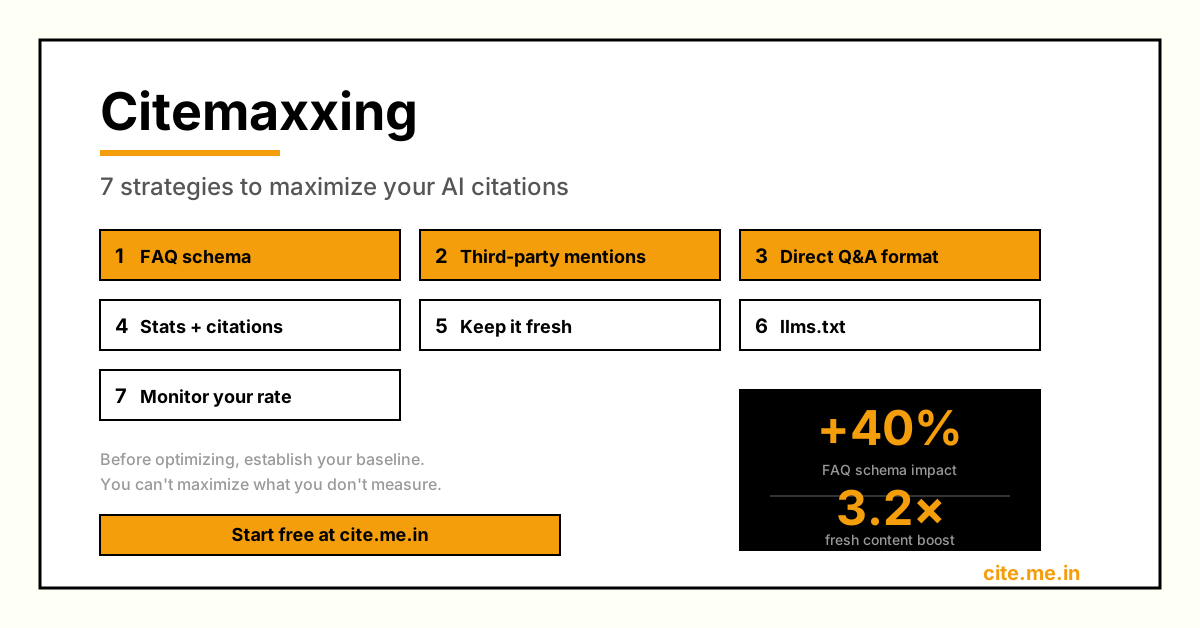
Seven strategies to systematically increase how often AI tools like ChatGPT, Perplexity, and Claude mention your brand — from FAQ schema to third-party mentions — and how to measure whether any of it is working.
You optimized for Google. Wrote the posts, built the backlinks, hit the keywords. Then you asked ChatGPT about your own category and — nothing. Not a mention. That gap is exactly what AI citation optimization closes.
AI citation optimization is the deliberate practice of maximizing how often AI tools cite your brand. It’s a distinct discipline from SEO — same instinct to be findable, different rules for what “findable” means. AI engines prioritize direct answers, structured content, and external validation. Almost nobody is optimizing for these signals yet.
The strategies are learnable, repeatable, and measurable. This post covers the seven that actually move the needle.
1. Add FAQ schema to your key pages
FAQ schema is the single fastest structural change you can make to improve AI citation rates.
It works because it gives AI engines exactly what they want: pre-structured question-answer pairs that are trivial to parse and cite. When ChatGPT or Perplexity encounters a page with FAQPage schema, it doesn’t have to infer the answer from paragraphs of prose. The question and answer are explicitly marked up.
Here’s how to do it:
- Identify the 5–8 questions your customers ask most about your category
- Add a visible FAQ section with clear, concise answers (40–65 words each)
- Mark it up with
FAQPageschema so AI engines can parse it programmatically - Keep answers factual and specific — vague language doesn’t get cited
The overlap between what your customers ask and what AI users ask is probably 80%+. If you have a product page, add an FAQ section there. If you’re running a blog, add FAQ sections to your highest-traffic posts. Either way, schema it.
2. Get mentioned by third-party sources
Third-party mentions are the strongest signal AI engines use to decide who to cite. Your own website is one data point. Every other site that mentions you is independent confirmation.
The AI isn’t just reading your marketing — it’s reading what everyone else says about you. A brand that appears on G2, gets discussed on Reddit, and shows up in three industry newsletters is a richer signal than a brand that only exists on its own domain. More external mentions, more citations.
The most impactful third-party sources:
- Industry directories — Get listed in every credible directory for your category
- Review sites — G2, Capterra, Product Hunt, AlternativeTo
- Newsletter mentions — Reach out to curators in your niche
- Community posts — Reddit threads, Hacker News, indie hacker forums
- Press coverage — Even small publications add signal
Don’t chase volume. One mention from a site the AI trusts is worth more than fifty from sites it doesn’t index. Focus on authoritative, topic-relevant sources.
3. Write content that answers direct questions
AI engines optimize for direct answers. Content that asks a question and immediately answers it gets cited more than content that buries the answer in narrative.
This doesn’t mean writing like a FAQ page for everything. It means structuring your content so that key claims are easy to extract:
- Open sections with bold thesis statements — The first sentence of each section should state the point directly
- Use descriptive headings — “How FAQ schema improves AI citations” beats “Optimization techniques”
- Put answers before context — Lead with the answer, then explain why
- Keep paragraphs short — 2–3 sentences per paragraph makes extraction easier
- Use lists for steps and rankings — AI engines parse bullet and numbered lists reliably
“The best content for AI citations is the same content that’s best for impatient humans: clear claims, short paragraphs, no filler.”
— Assaf Arkin, Co-Founder at cite.me.in
Make your content scannable by humans and parseable by machines. The two goals align more often than you’d think.
4. Add statistics and cite your sources
Specific numbers get cited. Vague claims don’t.
Compare these two statements:
- “AI traffic is growing fast”
- “AI-referred sessions grew 527% year-over-year in early 2025”
The first is filler. The second is a citation magnet. AI engines gravitate toward specific, attributable claims because they can verify them against the source.
Make this a habit across your content:
- Replace vague language with concrete numbers wherever possible
- Link to the original source for every statistic you cite
- Use percentages, absolute numbers, and time frames together
- Update statistics regularly — stale numbers erode trust and citation rates
Research shows that adding statistics to content increases AI visibility by 37%. Citing authoritative sources adds another 40% on top. Combined, that’s nearly a doubling of citation potential from two changes that take minutes per page.
5. Keep your content fresh
AI engines weight recent content heavily. Pages updated within the last 30 days are cited 3.2x more than stale pages.
This doesn’t mean publishing new posts every week. It means updating existing content regularly:
- Refresh statistics — Swap outdated numbers for current ones
- Add new sections — Expand coverage of evolving topics
- Update dates — Use
dateModifiedschema to signal freshness - Fix broken links — Dead links signal neglect
- Add recent examples — New case studies keep content relevant
Set a monthly reminder to review your top five pages. Even small updates — a new statistic, a refreshed example — can reset the freshness signal and improve your citation rate.
6. Build a llms.txt file
llms.txt is a plain text file at the root of your domain that tells AI crawlers what your site is about. Think of it as robots.txt but for LLMs.
It’s a simple file with big implications:
- Purpose — Provides a concise, machine-readable summary of your product or service
- Format — Plain text, structured with markdown headings, typically under 500 words
- Placement — Host at
yourdomain.com/llms.txt - Content — What you do, who it’s for, key features, pricing, how to get started
Not every AI engine reads llms.txt yet, but adoption is growing. It’s a five-minute investment that positions you for the platforms that do use it. Write it like you’re explaining your product to someone who has never heard of it — because that’s exactly what you’re doing.
7. Monitor your citation rate
You can’t maximize what you don’t measure.
Optimizing your AI citations without monitoring is just guessing with extra steps. You need to know which queries trigger citations, which platforms mention you, and whether your optimization efforts are actually changing anything.
What to track:
- Citation rate by platform — What percentage of relevant queries mention you on ChatGPT vs Perplexity vs Claude
- Citation rate by query — Which questions you appear in and which you don’t
- Trend over time — Whether your rate is improving, flat, or declining
- Competitor comparison — How your citation rate stacks up against direct competitors
cite.me.in handles all of this automatically. You add your domain, we generate category-specific queries, run them across ChatGPT, Perplexity, and Claude on a schedule, and deliver weekly reports with your citation rate and trends. Free for 25 days, no credit card required.
If you’re going to invest time in improving your AI citations, start by establishing your baseline. Otherwise you won’t know if the work is paying off.
Your AI citation checklist for this week
These strategies compound. FAQ schema makes your content parseable. Statistics make it citable. Third-party mentions make it authoritative. Freshness keeps it relevant. Monitoring tells you what’s working. Together, they create a flywheel: better structure leads to more citations, which leads to more third-party mentions, which leads to even more citations.
But you don’t have to do everything at once. Start here:
- Today — Add FAQ schema to your top two pages. This is the highest-impact, lowest-effort change.
- This week — Submit your product to two directories or review sites (G2, Product Hunt, AlternativeTo — pick what fits).
- This week — Update one statistic on an existing post and add
dateModifiedto its schema. - This week — Create a
llms.txtfile. It takes five minutes. - Before you do any of the above — Check your baseline citation rate at cite.me.in. You need a number to improve on.
AI citation optimization isn’t a one-time project. It’s an ongoing practice — and the brands that start now will have a compounding advantage over the ones that wait.
FAQ
What is AI citation optimization?+
Is this just SEO for AI?+
How long does it take to see results?+
Do I need FAQ schema to get cited?+
Which AI platforms should I focus on?+
How do I track my citation rate?+
Can I improve citation rates without writing more content?+
What's the single highest-impact thing I can do?+
Monitor your AI citation visibility

Co-Founder at cite.me.in
Co-Founder of cite.me.in and software engineer with deep expertise in AI, search, and open source. Previously defined industry standards in BPM and authored books on Ruby and Apache Buildr. He builds the product and leads the technical vision behind cite.me.in's AI citation monitoring platform.