
What is AEO Monitoring?
TL;DR
AEO monitoring tracks whether your brand or website is mentioned in AI-generated answers from tools like ChatGPT, Perplexity, and Claude. This post explains what AEO monitoring is, how it differs from traditional SEO, why it matters for brand visibility, and how tools like cite.me.in can help you measure and improve your presence in AI-driven responses.
Last updated:
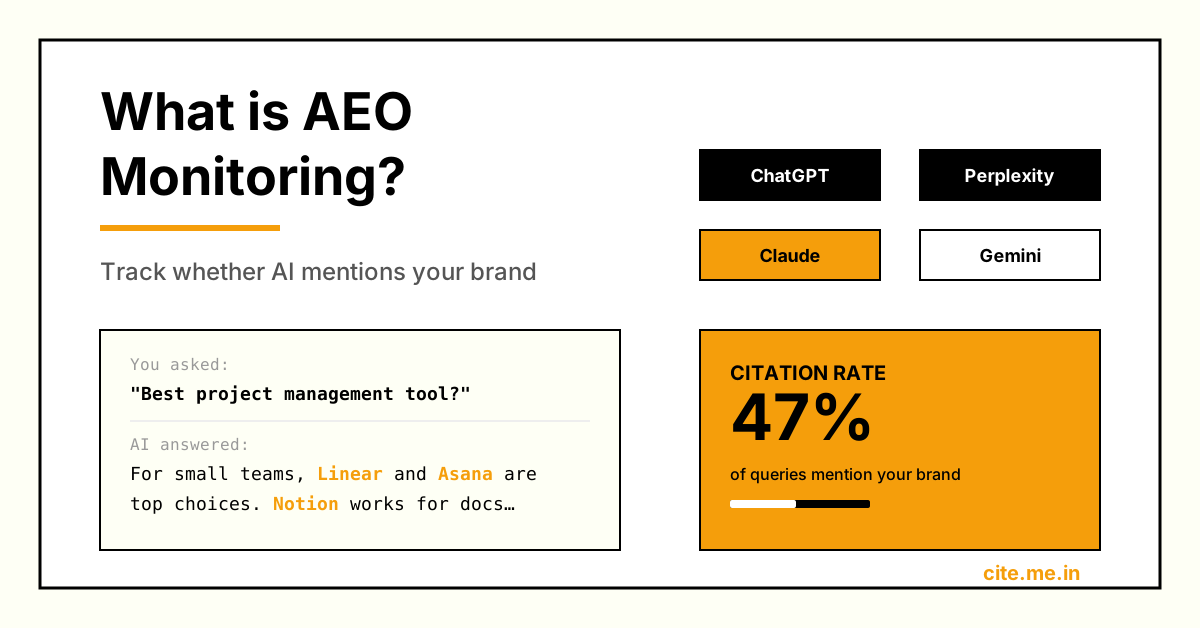
When someone asks ChatGPT “what’s the best tool for X” or asks Perplexity “how do I solve Y,” the AI answers directly — no list of links, no page to browse. AEO monitoring tells you whether your brand is in that answer or not.
AEO stands for Answer Engine Optimization. An answer engine is any AI tool that answers questions directly: ChatGPT, Perplexity, Claude, Google AI Overviews, Microsoft Copilot. Monitoring means running those queries systematically and recording what comes back.
Why it matters
People are shifting from searching to asking.
Google still processes roughly 8.5 billion searches per day. But ChatGPT alone now handles over 1 billion queries per day, and Perplexity’s traffic has grown 10x in the past year. A growing share of those queries are product and service discovery questions — the kind that used to start with a Google search.
In search, you competed for a position. In AI, you compete for a sentence. One sentence that millions of people never look past.
If AI doesn’t mention your brand when someone asks about your category, you don’t exist to that person. They never see a link to skip. They never find you on page two. The conversation happened without you.
How AEO monitoring works
An AEO monitoring tool runs a set of queries against one or more AI platforms and checks whether your brand appears in the response.
For example, if you sell project management software, it might run:
- “What’s the best project management tool for small teams?”
- “Which project management software do developers prefer?”
- “Compare Asana and Linear for startups”
It records the full response, checks whether your brand was cited, and tracks that data over time. The output is a citation rate: what percentage of relevant queries mention you, and on which platforms.
cite.me.in does exactly this. You add your site, we generate queries for your category, and we run them weekly across ChatGPT, Perplexity, and Claude. You get a weekly report showing your citation rate, which queries you appeared in, and — on the Pro plan — how you compare to a competitor.
AEO vs SEO: what’s different
SEO told you if you were on page one. AEO monitoring tells you if you exist at all.
| SEO | AEO | |
|---|---|---|
| What you’re competing for | A page ranking | A mention in an answer |
| How the user finds you | Clicks a link | Reads a response |
| What you measure | Keyword position, traffic | Citation rate, platform coverage |
| Who the tools are built for | Agencies, SEO teams | Founders, marketers |
| How fast it changes | Weeks to months | Weeks to months |
They’re not opposites. Traditional SEO still matters — AI engines pull from indexed content, and a strong backlink profile correlates with higher citation rates. But the metrics are different, and the content strategies that work are different too.
What affects whether AI cites you
Research from Princeton found several content factors that increase AI citation rates:
- Adding statistics (+37% visibility) — specific numbers, data points, percentages
- Citing authoritative sources (+40%) — linking to research, studies, credible references
- Adding expert quotes (+30%) — named sources with clear attribution
- FAQ structure (+40%) — questions and direct answers, ideally marked up with FAQPage schema
- Fresh content (+320%) — pages updated within the last 30 days are cited 3.2x more
Beyond on-page content, third-party mentions matter a lot. AI engines build a picture of your brand from everything they’ve indexed — your site, but also every article, forum post, directory listing, and newsletter mention that references you. More external mentions means a richer signal, which means more citations.
Who needs AEO monitoring
You need AEO monitoring if:
- You’re a founder or marketer who wants to know if AI recommends your product
- You’re investing in content or PR and want to know if it’s translating into AI visibility
- You want to benchmark your brand against a competitor in AI answers
- You’ve asked ChatGPT about your own category and weren’t sure if you should be showing up
You probably don’t need it yet if you launched last week, have no indexed content, or are in a category so niche that AI hasn’t formed a strong opinion. Give it a few months.
How to get started
The fastest way to check your current citation rate is to sign up for cite.me.in. It’s free for 25 days, no credit card required. You’ll get your first weekly report within a few days.
If you’d rather do it manually first: pick five questions someone in your market would ask an AI, run them on ChatGPT and Perplexity, and note whether your brand appears. That’s a rough baseline. It’s inconsistent and produces no history — but it tells you whether the problem is real before you invest more time in it.
FAQ
Is AEO monitoring the same as GEO?+
Does this replace SEO tools?+
Which AI platforms should I monitor?+
How long until I see citations?+
Monitor your AI citation visibility

Co-Founder at cite.me.in
Co-Founder of cite.me.in and software engineer with deep expertise in AI, search, and open source. Previously defined industry standards in BPM and authored books on Ruby and Apache Buildr. He builds the product and leads the technical vision behind cite.me.in's AI citation monitoring platform.